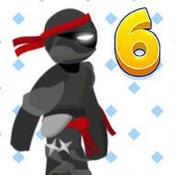
What happens when you mistime a jump over a spike pit in Vex 6 by a single frame? You die, instantly, and you’re staring at the checkpoint screen before you’ve even fully processed what went wrong. That’s the question every new player ends up asking themselves within the first minute, because the answer never softens — one bad read on a trap and the stickman is gone.
| Genre |
Precision obstacle-course platformer |
| Controls |
Arrow keys |
| Series entry |
Sixth installment in the Vex series |
Running and Wall-Jumping in Vex 6
The stickman in Vex 6 can run, jump, flip, wall-jump, slide, swim, and carry objects, and the core loop is built around chaining those moves together without breaking stride. None of these actions are difficult in isolation — the challenge is that each Act expects several of them back to back, with almost no room to stop and reassess between one obstacle and the next.
Wall-jumping specifically shows up whenever a corridor narrows into a vertical shaft, and it’s one of the mechanics that trips up players coming from simpler platformers, since the timing window for kicking off a wall in Vex 6 is tighter than it looks. Momentum carries between moves too, so a wall-jump chained straight into a running jump behaves differently than the same jump attempted from a standstill.
Because there’s no combat and no health bar to buffer mistakes, every one of these movement options exists purely to get the stickman past a hazard rather than to fight anything, which keeps the pace of Vex 6 feeling more like a reflex puzzle than an action game.
Spinning Saws and Spike Pits in Vex 6
Spinning saw blades patrol fixed paths across multiple Acts, and unlike a stationary hazard, they demand you clock their cycle before committing to a jump through their space. Spike pits sit below platforming sections and punish over-jumping just as harshly as under-jumping — landing a hair too far forward is just as fatal as coming up short.
What catches newer players off guard is that these two hazards are rarely presented alone. A stretch of Vex 6 will frequently combine a saw’s sweep with a spike pit directly underneath the safe gap, so clearing it means threading a narrow window in both space and time at once rather than solving one problem and moving on.
There isn’t a way to slow this down or preview it beyond memorization through repeated attempts, which is part of why checkpoints matter as much as they do — Vex 6 expects failure as part of learning a section, not as a sign you’re playing it wrong.
Timing Laser Fields in Vex 6
Laser fields pulse on a steady beat, opening a brief window to sprint through before they cycle back on. Unlike the saws, which move in continuous predictable arcs, the lasers reward pure rhythm reading — watching the beat once, then committing fully on the next cycle rather than hesitating partway through the gap.
Hesitation is the single biggest mistake players make against laser sections in Vex 6. Stopping halfway to reassess almost always means getting caught by the next pulse, since the safe window is short enough that a full-speed run is usually the only way through it cleanly.
Later Acts stack laser fields with moving platforms underneath them, which turns a simple timing check into a combined test of positioning and rhythm at the same time.
Disappearing Platforms and Moving Platforms in Vex 6
Disappearing blocks add a countdown element on top of the usual platforming — a surface that looks solid can vanish the instant your weight lands on it, forcing a jump to the next foothold before you’ve had a chance to plant and think. Moving platforms complicate this further by shifting the target itself, so a jump has to account for where a platform will be rather than where it currently is.
Combining the two is a recurring pattern deeper into Vex 6 — a moving platform that also happens to be a disappearing one, which means both the position and the timing window are constantly changing under you.
Cannons show up in some of these same stretches, launching the stickman across gaps that would otherwise be too wide to clear on foot, which adds a moment where you have almost no control over the trajectory once you’ve stepped in.
Swimming and Carrying Objects in Vex 6
Water sections slow the pace down deliberately, swapping fast reflex platforming for slower, more deliberate swimming through submerged stretches of an Act. It’s a rare break from the sprint-and-jump rhythm that dominates most of the game, though the hazards inside water sections still punish careless movement the same way solid ground does.
Carrying objects is a smaller mechanic but shows up often enough to matter — certain sections require picking something up and holding onto it through a platforming stretch, which limits your options mid-jump since you can’t always react to a hazard the same way you would empty-handed.
Neither mechanic gets much attention next to the saws and spikes, but both change the rhythm of an Act enough that a player used to pure running-and-jumping can get caught out the first time either one shows up.
The Vexation Finale in Every Vex 6 Act
Every one of the nine Acts in Vex 6 closes with a stage called Vexation, and it’s built to combine most of the trap types introduced earlier in that Act into one longer, meaner gauntlet. Where a regular stage might isolate a saw section or a laser section, Vexation tends to string several hazard types together with barely a pause between them.
This is where the difficulty curve of Vex 6 becomes obvious even to players who breezed through the earlier parts of an Act. A Vexation stage isn’t testing anything new mechanically — it’s testing whether everything learned across that Act can be executed under pressure, back to back, without a single reset in concentration.
Casual players tend to treat Vexation as the real wall of each Act, the point where a run either clicks or falls apart repeatedly against the same short stretch.
Hard Acts: Vex 6’s Harder Second Pass
Clearing a regular Act unlocks its Hard Act version, which reuses the same layout but tightens everything that made it dangerous the first time — faster traps, stricter timing windows, and effectively no margin for a sloppy input. It’s the same map mentally, but the execution bar is raised enough that muscle memory from the normal Act only gets you partway through.
For players chasing every completion Vex 6 offers, Hard Acts are where the real challenge lives, since the base Acts mostly exist to teach the hazard vocabulary that the Hard versions then demand you execute at speed.
Speedrun-minded players in particular gravitate toward Hard Acts, since a clean run there says more about actual mastery of Vex 6’s movement system than a first clear of the standard version ever could.
Coins and Skins in Vex 6
Vex 6 introduced collectible coins scattered through each level for the first time in the series, and those coins go toward unlocking cosmetic skins for the stickman — 64 of them in total. It’s a purely cosmetic system that doesn’t affect movement or difficulty, which keeps the collecting separate from the actual platforming challenge.
Grabbing every coin in a stretch usually means detouring slightly off the fastest line through an Act, so there’s a small tension between playing for a clean, efficient run and playing to collect everything a level has scattered around its hazards.
Daily tasks and a rotating daily bonus stage give players a reason to come back even after finishing the main Acts, offering coins without requiring another full lap through Vexation.
Checkpoints and Daily Bonus Stages in Vex 6
Checkpoints save progress within a stage so a death doesn’t send you back to the very start of an Act, which matters enormously given how often Vex 6 expects trial-and-error against a specific trap combination. Without them, the game’s difficulty would be closer to punishing than fair; with them, failure becomes a normal part of learning a section rather than a full setback.
The daily bonus stage rotates in as a separate short level outside the main Act structure, giving a smaller, self-contained challenge alongside whatever daily tasks are active that day.
New players sometimes assume checkpoints will carry them through a whole Act on autopilot, but each one only resets you to that specific point — the trap ahead still has to be solved fresh every time you reach it.
- How many acts does Vex 6 have? Vex 6 has nine Acts, each with its own Hard Act variant and a closing Vexation stage, so there are effectively three difficulty layers to work through per Act.
- What do coins do in Vex 6? Coins collected during a level go toward unlocking cosmetic stickman skins, 64 in total, marking the first time the series has included in-level collectibles like this.
- How do you unlock Hard Acts in Vex 6? Clearing a regular Act unlocks its Hard Act counterpart automatically, which keeps the same layout but raises the speed and precision demands considerably.
Vex 6 keeps circling back to the same lesson every Act reinforces: the saws, the lasers, and the Vexation finale that closes each one aren’t obstacles to memorize once and forget, they’re a vocabulary the game keeps testing you on at higher speed the deeper you go.